

Imagination Ignited
FireQuill is the writing platform for long-form authors: novels, non-fiction, podcasts, and more. From first spark to final draft, we hold your characters, arguments, and voice together across the whole book.
Most AI writing tools generate.
FireQuill remembers.
Most AI writing platforms are text machines. You prompt; they output. The output gets longer; the book stays shallow. The character who started as a stoic detective in Chapter One is suddenly cracking jokes in Chapter Twelve. The argument that began with rigor in Section One drifts by Section Eight. The threads you planted unravel.
FireQuill is built on a different bet: a book is a system, not a sequence of paragraphs. So we built the system. A dynamic engine that holds every character’s voice, psychology, knowledge, and arc, scene by scene, snapshotted, queryable, evolving with the manuscript itself. A roster of agentic specialists that read every chapter the way a professional editor would. A generation pipeline that pauses at every creative fork and asks: where do you want this to go?
This isn’t a chatbot. It’s an architecture.
Built for writers who hate AI slop.
The reason AI prose feels generic is that the prompt was generic. FireQuill makes the prompt impossible to be generic.
"AI writes generic prose."
Eight layers of structural setup before a word is written. Genre, archetype, narrative framework, character psychology, voice samples, comps. The agent isn’t guessing. It’s executing your design.
"My characters will sound the same."
Every character has a voice centroid built from samples you authored. The voice validator catches drift on every paragraph and flags it before it ships.
"I'll lose my voice."
We never auto-correct your prose. Validators flag; you decide. Dismissed flags are remembered; the system stops crying wolf in the same place twice.
"AI loses the plot by chapter five."
Plot validator + continuity validator + character snapshot per scene. The drift budget catches voice, arc, and plot drift across the full book.
"Is it really my book if AI helped?"
You designed the frame. You authored the characters. You picked every fork. Every word traces to a decision you made. The agent is a typist, not an author.
“AI slop is what happens when you prompt and pray. FireQuill doesn’t generate. It orchestrates.”
The slop you’ve read elsewhere came from a prompt like “write a chapter where the detective discovers a clue.” No psychology. No voice. No context. No structure. The model fills the void with averages: clichés, generic dialogue, the most-likely- next-word over and over.
FireQuill makes that prompt impossible. By the time the chapter agent sits down, it has the wizard’s bible (frame, premise, themes, plot archetype, narrative framework), the active cast with full voice samples plus psychology plus current arc state plus recent state changes, the chapter’s outline beat, the prior chapter’s summary, an emotion brief from the informer agent, grounding passages from any research sources you’ve uploaded, and your house style rules. The prompt isn’t generic. It can’t be generic. The math doesn’t allow it.
The character is the platform.
Most AI writing tools treat a character as a name tag in a prompt. FireQuill treats them as the center of gravity: a versioned, living object that every engine in the system orbits.
Characters live at the account level, in the Character Forge: a dedicated workstation where you build them chapter by chapter — identity, origin, drive, psychology, voice, arc, ties — as deep as the story demands. Forge them once, then send them into any book, script, or show. Every scene they enter reads their current state. Every scene they leave updates it.
The Character Forge — build a character as deep as the story demands, then cast them anywhere.
A character who actually changes.
Voice, psychology, knowledge, relationships, arc trajectory, all versioned per scene. Time-travel through your protagonist’s evolution.
Every character in your manuscript carries a structured object that the engine maintains alongside your prose. As you write, FireQuill’s extractor agent reads each scene and proposes updates to that object: a new fact the protagonist learns, a relationship that shifts, voice that slowly hardens. You accept or reject each proposal. The engine snapshots the state per scene so you can rewind.
For non-fiction, the same mechanism powers an Expert Panel: each domain expert in your book carries methodology, blind spots, key sources, and consultation voice. The editor agents draft as them, citing sources, surfacing perspective.
Talk to your characters. Consult your panel.
Stress-test dialogue with your protagonist. Ask your contrarian expert to demolish your central argument. Every voice in your book becomes a reachable collaborator.
Open the Cast tab in the editor and pick a character. They reply as them: voice samples plus psychology plus current arc state plus every recent extraction packed into the persona. Test a piece of dialogue before you commit it. Throw a hypothetical at your antagonist and watch the reaction. Workshop a confrontation scene from the inside.
Non-fiction’s Panel tab does the same with experts. Pick the contrarian on your panel and ask them to find the weakest claim in your latest section. Now your “kill your darlings” pass has muscle.
Direct your book like a film.
Auto-generate paragraph by paragraph and pause at every creative fork. The agent offers three to four directions; you pick the one that lands. Or write your own.
Auto-flow generation is unattended; Director’s Mode is the opposite: maximum agency. The chapter agent writes a paragraph, hits a decision point, and surfaces three to four trajectories: short labels, summaries, and 100-word in-voice previews. Sarah confronts him in the rain. Sarah lets him walk away, and follows. Sarah’s brother arrives, changing the calculus.
You pick. The book commits. Or type your own direction in plain English and the agent honors it. Repeat fork by fork.
Every word in your draft traces back to a decision you made. You stay the author. The agent stays the typist.
A roster of specialist editors, on demand.
Developmental, line, plot, continuity, argument, evidence, counterargument, audience-fit: eight specialists trained as specialists, not as generalists pretending.
Most AI editors are one model trying to be everything. Ours are eight agents, each prompted, calibrated, and tested against fixtures for one job. The line editor doesn’t try to spot plot holes; the plot editor doesn’t critique sentence rhythm. Each returns a verdict, severity, and confidence: flag, don’t block. They never auto-correct your prose. They surface notes in a triage inbox; you accept, defer, or dismiss.
The system also catches itself: every dismissed flag is recorded; every override logged. Patterns become signal: characters whose voice flags get dismissed repeatedly get a “voice drift might be authorial intent” treatment.
Developmental
Reads each chapter for pacing, cohesion, setup-payoff health, and act-structure fit.
Line
Diction, rhythm, dead verbs, modifier sprawl, dialogue-tag overuse. Sentence-level craft.
Plot
Causal-chain checks across scenes. Setup, payoff, motivation visibility, agent of change.
Continuity
Knowledge state, timeline, object location. Catches the things you’ll never notice yourself.
Argument
Per-chapter argumentative coherence. Claim, support, warrant, hidden assumption.
Evidence
Claim-evidence proximity, source quality, citation-style consistency.
Counterargument
The objections your chapter doesn’t engage with. Surfaces fair-minded pushback.
Audience-fit
Reading-level enforcement, jargon density, assumed-knowledge calibration.
Each verdict returns pass / warn / fail × cosmetic / notable / serious / breaking × low / medium / high confidence. Not “great chapter, consider tightening pacing.” Calibrated, scoped, traceable, false-positive-tested.
Every flag becomes a lesson.
The validators catch your patterns. Teach Mode turns them into craft you keep: a coach that reads your book, streams the principle behind each flag, and lets you practice the fix until it sticks.
Open the Coach in your side rail and it’s grounded in your manuscript: your premise, your characters, and the patterns you get flagged for most. Ask it anything, or hit “Teach me” on a flag and it streams a focused lesson tied to the exact passage: the principle, why it matters, and how to apply it.
Then you try it. Rewrite the flagged line in place; a judge checks your revision and celebrates when you land it. It never touches your manuscript on its own. Clean fixes unlock milestones, and a growth dashboard tracks your craft climbing over time. Fiction or non-fiction, the coach speaks your track’s language.
Most AI writes for you. Teach Mode makes you a better writer.
Eight layers of structural depth, in fifteen minutes.
Plot archetype. Narrative framework. Premise. Themes. Cast or panel. Frame. Comparable works. The book’s bones, fully articulated, before you write a word.
Most platforms ask you to “describe your story” and start generating. FireQuill makes you do the structural work first, but makes it elegant. Eight layers. Booker’s seven plot archetypes, plus twelve additional narrative frameworks (Hero’s Journey, Heroine’s Journey, Time Loop, Save the Cat, Snowflake, more). Layered Jungian-inspired character archetypes. Genre-aware tone calibration.
Or use Holistic Setup: type a one-sentence pitch like “Mystery: a detective returns to her hometown to investigate a missing teen and uncovers her own buried family secret.” FireQuill drafts the full bible (frame, premise, themes, three to five characters with archetype plus want plus need plus flaw) in a single call. You review. You edit. Locked fields stay yours.
FireQuill is built on the bet that the work of writing is structural design, not typing. We make you do the design work, eight layers of it, before the typing starts. The agent isn’t replacing the craft. It’s amplifying it.
Write 80,000 words while you sleep.
Auto-Flow runs the chapter agent in a loop, validates every chapter through the editor specialists, accumulates drift, pauses on compound failure or budget breach. You wake up to a draft.
Press the autogen button. The chapter agent reads your bible plus outline plus prior chapters plus recent character updates and writes Chapter One. Inline validators fire (line, developmental, continuity for fiction; argument, evidence for non-fiction). If verdicts are clean, the chapter ships and the loop advances. If a single specialist flags a warning, the chapter regenerates with corrective context. If multiple flags compound, the run pauses at a checkpoint and emails you to review.
Every chapter writes to your manuscript chunk. You can roll back any chapter, or all of them. A cost ceiling stops runaway spend. A drift budget catches voice, arc, and plot drift across the full book.
One engine. Six ways to build a book.
Fiction and non-fiction carry the deepest machinery: a character engine or an expert panel, per-scene extraction, the full validator roster. Podcast, documentary, game, and musical each get a format-aware wizard and a generator tuned to how that form is actually built. Same engine. Different bones.
Most platforms bolt non-fiction on as an afterthought and stop there. FireQuill was built track-aware from layer zero, and the track list kept growing. Pick your form at the wizard’s first step and everything downstream reshapes: the vocabulary, the cast roles, the validators that fire, the questions the wizard asks, and the formats you export.
The two flagship tracks carry the full agentic depth. The four newer tracks share the wizard, the generation pipeline, and the export suite, tuned to their form. The vocabulary changes; the care doesn’t.
For novelists.
Genre, plot archetype, narrative framework, character archetypes, comps. Scene-level extraction.
- Dynamic Cast: voice, psychology, arc per scene
- Plot validator: causal chain across chapters
- Continuity validator: timeline, knowledge, location
- Line + developmental validators
- Cast Chat: workshop dialogue from the inside
For arguers.
Sub-format, reading level, scope facets, citation style. Section-level extraction.
- Expert Panel: methodology, blind spots, sources
- Argument + evidence + counterargument validators
- Audience-fit: reading level + jargon density
- Research sources: ground chapters in your own PDFs
- Panel Chat: stress-test claims with your experts
For hosts.
Conversational, narrative, or solo. The format is the first fork, and it reshapes everything.
- Format-aware wizard: host, guest, or narrator roles
- Structured episode beats, not loose prose
- Transcript or narration-script layout
- Episode scripts, ready to record
For truth-tellers.
Subject, filmmaker, and the discipline of access. Real-world story, sourced.
- Subject + filmmaker point of view
- Truth & access: sourcing and chronology rigor
- AV two-column screenplay output
- Fountain / Final Draft / PDF export
For world-runners.
Branching narrative with a coherent story state that survives player choice.
- Structure-aware: linear, branching, or anthology
- Story-state cast across every path
- Canonical-path script from a branching design
- Screenplay-format export
For composers.
Songs and book, plotted together. The libretto and the score, in step.
- Tradition-aware song placement + diegesis
- Character and song list built from the bible
- Print-ready libretto (PDF)
- Editable libretto (Word) for collaborators
And any finished project, in any track, can be adapted into a screenplay: type-aware craft for fiction, non-fiction, documentary, game, or musical sources, exported to Fountain, Final Draft, or PDF.
Everything around the words.
The manuscript is the center. The studio does the rest: faces for your cast, sources under your claims, and a shelf of export formats for wherever the book goes next.
Cast Portraits
Generate portraits for every character and expert: five art styles, three variants each, set your favorite as the avatar. Free to try; included on every paid plan.
Research Grounding
Upload your PDFs, docs, and notes. Non-fiction chapters draft from retrieved passages, so claims stay anchored to your own sources, not the model’s memory.
Ten Export Formats
Markdown, Word, EPUB, KDP-ready EPUB, and print PDF, plus Fountain, Final Draft, and libretto formats for screen and stage. Stable, exportable, yours forever.
Where books become productions.
FireQuill doesn’t stop at prose. Five dedicated workstations take the same story bible into casting, worldbuilding, screen, air, and audio.
Your characters, under contract.
The roster view of character-first: every character and expert you own, with their credits, followers, and voice. Forge new ones, send them into books, and watch their record grow — roles stack up the way credits stack on an actor’s résumé.
A universe your books share.
Places, ages, peoples, powers — built once in a dedicated worldbuilding workstation, then compiled straight into any project’s story bible. Write three books in the same world and the rules hold in all three.
From manuscript to screen.
Adapt a finished book scene by scene — you approve the cut list before a page is drafted — or write an original script from your outline. Industry-standard formatting, hand-edited lines that survive a re-adapt, and Fountain, Final Draft, and PDF export.
Put your story on air.
Import a podcast project as a show, cast its voices from your roster, and lay out every episode segment by segment. Casting and show setup are live today; full episode generation is rolling out.
Your book, read aloud.
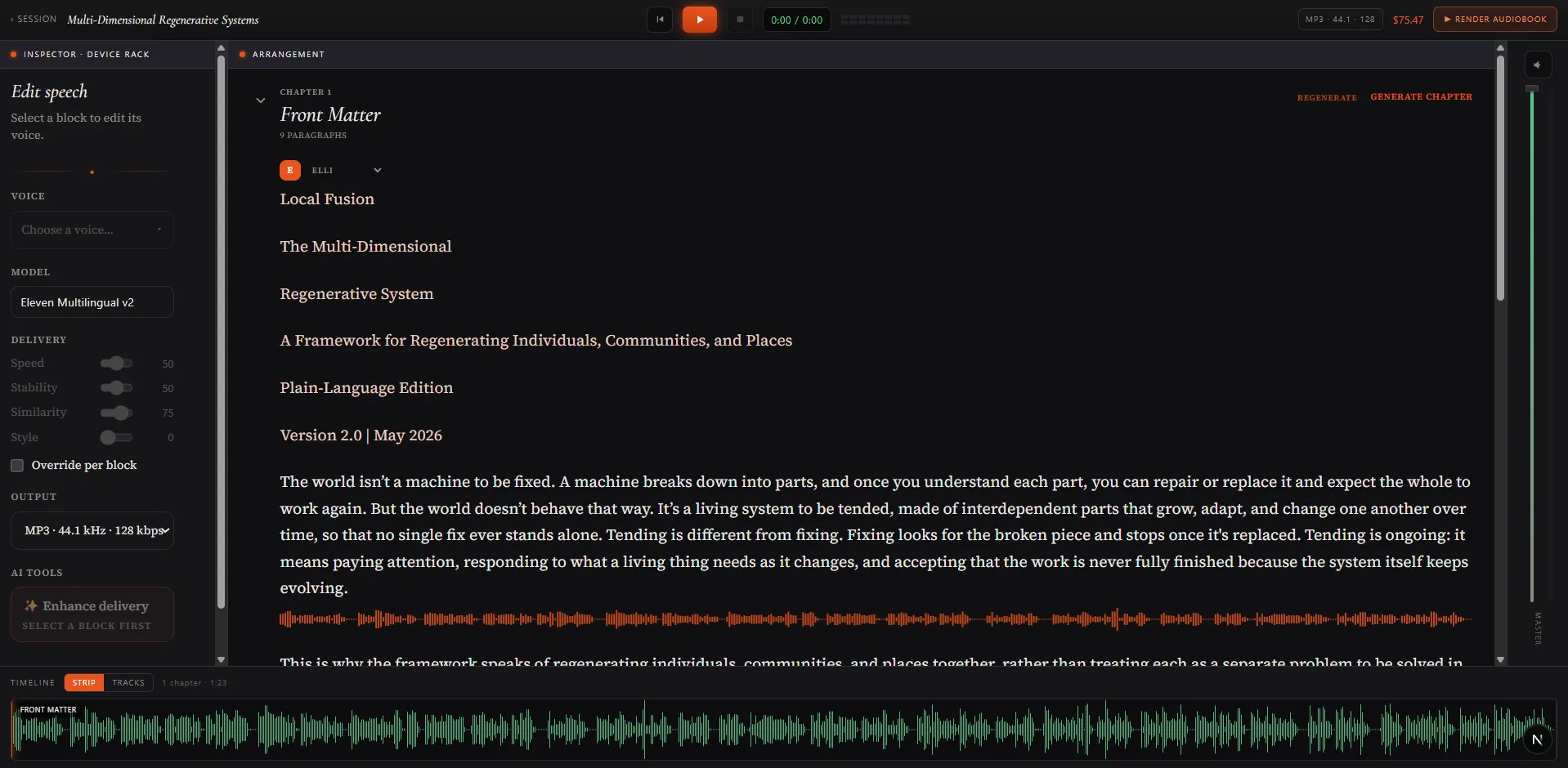
A full DAW workstation for narration: cast a voice, tune delivery block by block, scrub the waveform timeline, and render the whole book straight to MP3. No separate tool, no export dance.
Already on the workbench.
What’s coming next quarter.
Web-Search Research Validator
Upload-your-own research sources ship today. Next: claims that need checking get verified against live web search, citations attached. Pro tier.
Sensory, Subtext & Pacing Informers
Pre-generation specialists that brief the chapter agent on what the prose should feel, imply, and pace toward.
Collaborative Storyverse
Share characters and worlds, follow the authors you love, and adopt a character into your own book, with attribution that travels.
Essay Mode
Essays and essay collections as a first-class home: a continuous, focus-minded editor built around your own sections, not chapters.
Multi-Track Hybrid Books
Memoir bridges fiction and non-fiction. Both engines, in one project.
Start free. Upgrade when your book demands it.
Your writing partner.
- Core writing intelligence
- AI chat companion, always in your story’s context
- AI passage checks + paragraph rewrites
- Character portraits and a cover each month
- 3 active projects · you write; FireQuill sharpens
The author’s desk.
- Premium model ensemble — a dedicated story architect plans your book, a premium writer drafts it
- The full book-writing engine — one complete book a month
- Director’s Path guided generation
- Learn mode: your writing tutor
- Real-world expert research + source library
- 10 active projects
The studio.
- Flagship ensemble — our most advanced intelligence at every stage
- One full production a month — a book or a screenplay adaptation
- Premium chat
- Priority support + early access to new features
- 25 active projects
Free plan: the manual editor and wizard with 2 projects, no AI. Save 15% with annual billing — effective monthly: Companion $8.50, Author $17, Studio $25.50. Audiobook + podcast narration are pay-as-you-go on any paid plan.
Build your book the way it’s actually built: as a system.
Sign-up takes thirty seconds. The wizard takes fifteen minutes. The first chapter takes an hour, or a night, or however long the work of writing actually takes.
Start Writing for Free →